Modular Local AI Assistant with Voice Interaction, Persistent Memory, and Extensible Architecture
JARVIS
JARVIS is a modular AI assistant designed to run locally while combining voice interaction, persistent memory, local language models, and an extensible software architecture. The long-term vision is to evolve JARVIS into an intelligent desktop operating layer capable of automating workflows, understanding its environment, and acting as a personalized AI companion.
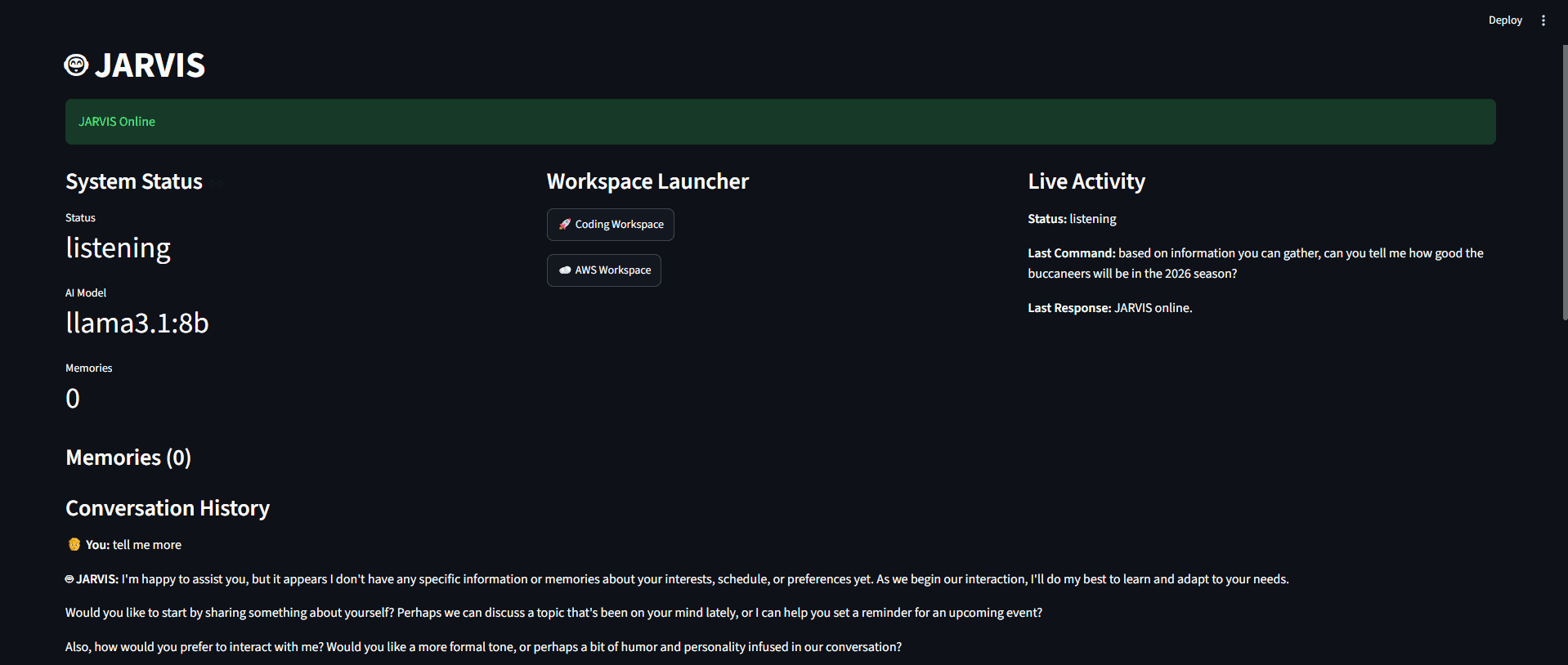
Project Overview
Language
Python
Architecture
Modular
AI
Local LLM
Status
Active
Engineering Timeline
Foundation
Developed the initial voice assistant with speech recognition, text-to-speech, and a command routing system.
Persistent Memory
Implemented SQLite and SQLAlchemy to allow JARVIS to remember information between sessions.
Local Intelligence
Integrated Ollama to provide private local language model inference without requiring external AI APIs.
Future Expansion
Currently expanding toward desktop automation, computer vision, email management, calendar integration, and multi-agent workflows.
The Problem
Most commercial AI assistants rely heavily on cloud infrastructure, have limited personalization, and provide little control over long-term memory or automation. I wanted to build an assistant that prioritizes privacy, local execution, modular software design, and future expandability while serving as a long-term engineering project.
The Solution
I designed JARVIS as a modular Python application that separates voice recognition, command routing, persistent memory, AI reasoning, and future integrations into independent services. Using SQLite, SQLAlchemy, SpeechRecognition, and Ollama allows the assistant to run locally while remaining highly extensible as new capabilities are introduced.
System Architecture
Component Details
Command Router
Purpose
Determines how every request should be processed and dispatches it to the correct service.
Responsibilities
- ✓ Intent detection
- ✓ Command routing
- ✓ Service dispatch
Technologies
Why It Exists
Separating routing from implementation keeps the architecture modular and easy to extend.
Key Features
- Wake-word voice activation
- Persistent long-term memory
- Local language model inference
- Modular command routing
- SQLite-backed memory storage
- Conversation history
- Extensible service architecture
- Offline-first design
Technology Stack
Engineering Decisions
Python
Why I Chose It
Python provides rapid development, excellent readability, and one of the strongest ecosystems available for AI, automation, and speech processing.
Trade-offs
- Lower runtime performance than compiled languages
- Excellent developer productivity
- Large AI ecosystem
Used For
- Application orchestration
- Voice processing
- Command routing
Ollama
Why I Chose It
Running language models locally keeps conversations private while allowing experimentation with different models without depending on cloud APIs.
Trade-offs
- Requires more local hardware resources
- No recurring API costs
- Offline operation
Used For
- Natural language understanding
- Conversation generation
- Question answering
SQLite
Why I Chose It
SQLite keeps deployment simple for a desktop application while providing persistent storage without requiring a database server.
Trade-offs
- Not intended for large concurrent workloads
- Extremely lightweight
- Simple deployment
Used For
- Persistent memory
- Conversation history
- Stored user information
Modular Architecture
Why I Chose It
Separating memory, AI services, routing, speech processing, and future integrations minimizes coupling and allows the assistant to evolve without major rewrites.
Trade-offs
- Slightly more initial design complexity
- Much easier long-term maintenance
- Highly extensible
Used For
- Feature isolation
- Future integrations
- Maintainability
Challenges
- Improving speech recognition reliability across different environments
- Designing scalable command routing
- Maintaining long-term conversational memory
- Integrating local language models efficiently
- Designing modular interfaces that allow new AI capabilities to be added without tightly coupling them to the existing assistant.
Lessons Learned
- Modular architecture makes it easier to expand the system without requiring major changes to existing components.
- Separating routing, memory, and AI services reduces long-term technical debt.
- Local language models require different optimization strategies than cloud APIs.
- Iterative development produces cleaner software than attempting to design every feature upfront.
Future Roadmap
- Desktop automation — allow JARVIS to execute controlled actions across the local operating system.
- Computer vision — connect cameras to enable object recognition and workspace awareness.
- Email automation — retrieve, summarize, categorize, and assist with email workflows.
- Calendar integration — manage events, scheduling, reminders, and time-based workflows.
- Home server integration — extend JARVIS beyond the local workstation to connected services and infrastructure.
- Multi-agent architecture — allow specialized AI agents to collaborate on complex tasks.
- Natural-language workflows — translate conversational requests into multi-step automated processes.
- Cross-device synchronization — maintain consistent memory, preferences, and workflows across supported devices.