AI-Powered Vehicle Diagnostics Using Hybrid Semantic Search
Vehicle AI Diagnostic
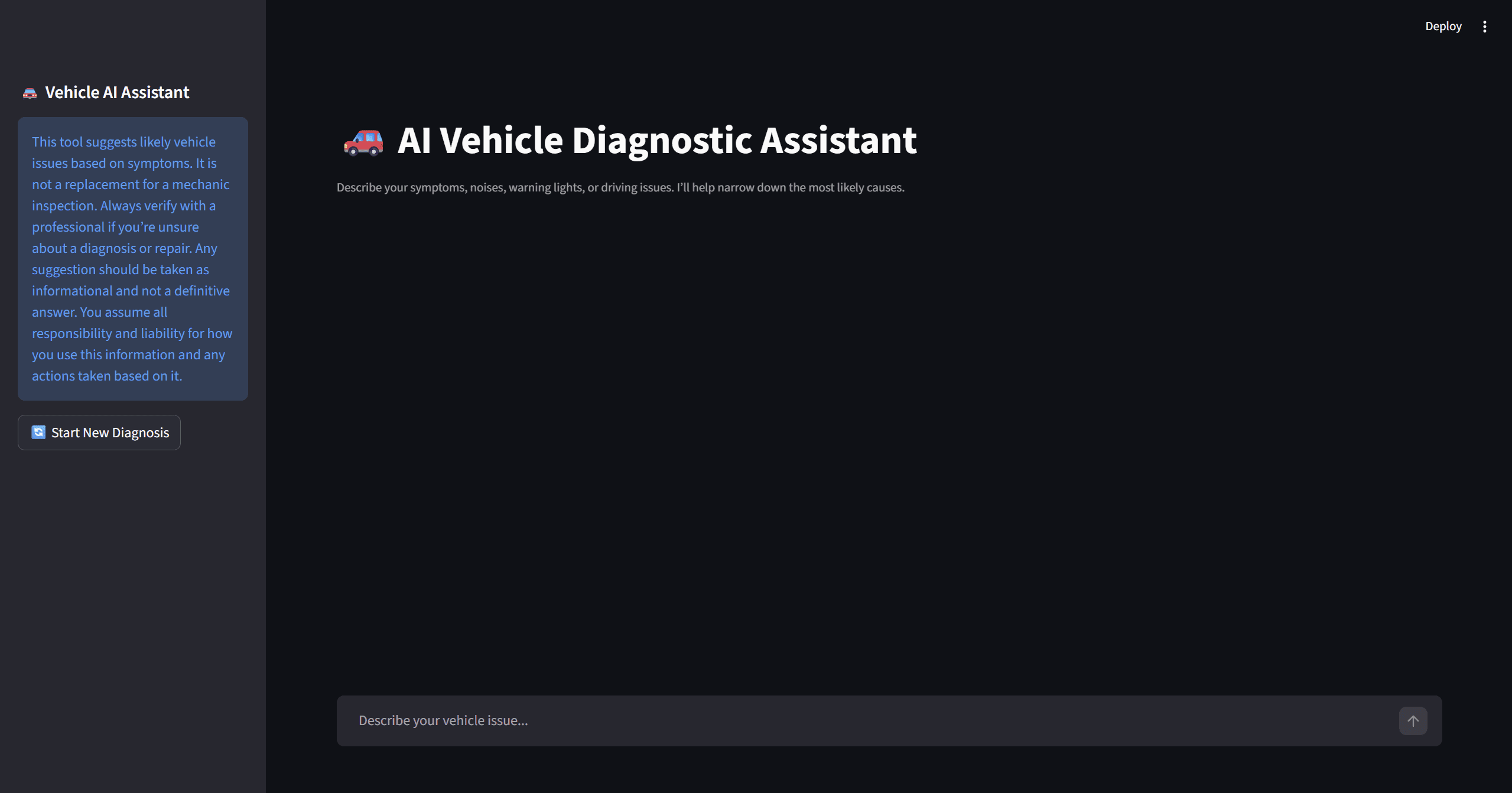
Vehicle AI Diagnostic is an intelligent troubleshooting assistant that combines traditional OBD-II diagnostic code lookup with semantic vector search to provide context-aware repair guidance. Rather than relying solely on exact fault codes, the system understands natural language descriptions of vehicle symptoms and retrieves the most relevant failures using AI-powered similarity search.
Project Overview
Dataset
50,000+ Fault Records
Search
Hybrid AI
Embeddings
Sentence Transformers
Vector DB
FAISS
Engineering Timeline
Research & Dataset Preparation
Collected and organized structured OBD-II codes together with thousands of documented vehicle fault records.
Semantic Search
Generated vector embeddings using Sentence Transformers and built a FAISS index for high-performance similarity search.
Hybrid AI Engine
Combined exact diagnostic code lookup with semantic retrieval to provide more intelligent troubleshooting recommendations.
Application Delivery
Developed a complete Streamlit application capable of interactive vehicle diagnostics using both traditional and AI-powered search techniques.
The Problem
Traditional OBD-II scanners provide generic fault code descriptions but rarely help users understand the underlying cause of a problem. Drivers often describe symptoms that do not directly correspond to a diagnostic code. I wanted to build a system capable of combining structured diagnostic information with semantic reasoning to produce more meaningful troubleshooting recommendations.
The Solution
I designed a hybrid diagnostic platform that combines exact OBD-II code lookup with semantic search powered by Sentence Transformers and FAISS. By embedding thousands of known vehicle faults into vector space, the application can retrieve failures that are semantically similar to a user's symptoms while still supporting precise diagnostic code lookups. The result is a more intelligent diagnostic assistant capable of reasoning beyond simple keyword matching.
System Architecture
Component Details
Sentence Transformer
Purpose
Converts symptom descriptions into dense vector embeddings for semantic comparison.
Responsibilities
- ✓ Generate embeddings
- ✓ Encode semantics
- ✓ Prepare vector search
Technologies
Why It Exists
Allows the system to understand meaning instead of matching keywords.
Key Features
- Exact OBD-II code lookup
- Natural language symptom search
- Semantic vector similarity search
- Large searchable fault database
- AI-assisted troubleshooting recommendations
- Interactive Streamlit dashboard
- Hybrid retrieval architecture
Technology Stack
Engineering Decisions
Sentence Transformers
Why I Chose It
Sentence Transformers convert user symptom descriptions into semantic embeddings, allowing the system to understand meaning rather than relying only on exact keyword matches.
Trade-offs
- Requires preprocessing to generate embeddings
- Significantly improves semantic understanding
- Enables flexible symptom searches
Used For
- Symptom embeddings
- Semantic retrieval
- Natural language search
FAISS
Why I Chose It
FAISS provides extremely fast nearest-neighbor searches across thousands of embedded vehicle fault vectors, making semantic search practical for interactive applications.
Trade-offs
- Requires index generation
- Very fast query performance
- Scales efficiently
Used For
- Vector indexing
- Similarity search
- Fault retrieval
Hybrid Search Architecture
Why I Chose It
Combining deterministic OBD-II lookup with semantic AI retrieval produces more reliable diagnostic recommendations than either technique alone.
Trade-offs
- More complex application logic
- Improved diagnostic accuracy
- Supports multiple search strategies
Used For
- Code lookup
- Semantic reasoning
- Diagnostic recommendations
Streamlit
Why I Chose It
Streamlit allowed rapid development of an interactive interface while keeping the primary engineering effort focused on AI and backend functionality.
Trade-offs
- Less customizable than React
- Rapid prototyping
- Excellent for AI demonstrations
Used For
- Application interface
- User interaction
- Diagnostic visualization
Challenges
- Generating embeddings for large datasets
- Balancing semantic accuracy with search performance
- Designing a hybrid retrieval pipeline
- Organizing structured and unstructured vehicle data
- Maintaining responsive search performance
Lessons Learned
- Hybrid retrieval systems outperform purely deterministic searches for many AI applications.
- Precomputed embeddings dramatically reduce runtime latency.
- Separating retrieval from reasoning creates a more maintainable architecture.
- Vector databases unlock entirely new user experiences compared to traditional search.
Future Roadmap
- Live OBD-II scanner integration
- VIN decoding
- Predictive maintenance recommendations
- Repair cost estimation
- Multi-vehicle profiles
- Cloud synchronization
- Voice-powered diagnostics
- Mobile application